
THE RESULTS ARE IN!!!!!
Your child : Needs more support right now
This result indicates that your child may need more intentional support before taking on the full demands of college. 🤝
What this means for you as a parent:
This result might scare you a bit and I completely understand that, but isn't it better to know now, before they actually start college?? I sure would appreciate making sure my child has everything they need !
But there is still plenty to celebrate:
1. First, YOUR CHILD put in (or is still putting in the work) to successfully get through high school. Among many other things, they have learned new material, explored some new strategies for learning, and likely had some opportunities to make decisions that maybe weren't the easiest (does staying home and studying rather than go out with their friends sound familiar?)
2. YOU also put in work. And obviously are continue to put in work right now! In wanting your child to succeed, I suspect you may have helped them with things they needed like reviewing for tests/quizzes, checking Powerschool to ensure they were keeping up with their work, maybe a few emails to teachers?
3. And finally their TEACHERS have been in this journey with you. (Maybe I am a bit partial because I am one of those teachers ) but alongside of you, they were helping your child too. Hopefully they were giving them opportunities to develop time management skills, learn new study methods....
And because of all that.....
➡️It means your child is entering college with a few of the skills they’ll need to navigate academics and support systems more independently.
(I KNOW that helps put you at ease ......)
➡️ It means they will benefit by beginning to understand their learning needs in order to articulate what helps them learn best. With this knowledge that will be able to advocate for themselves in ways colleges expect.
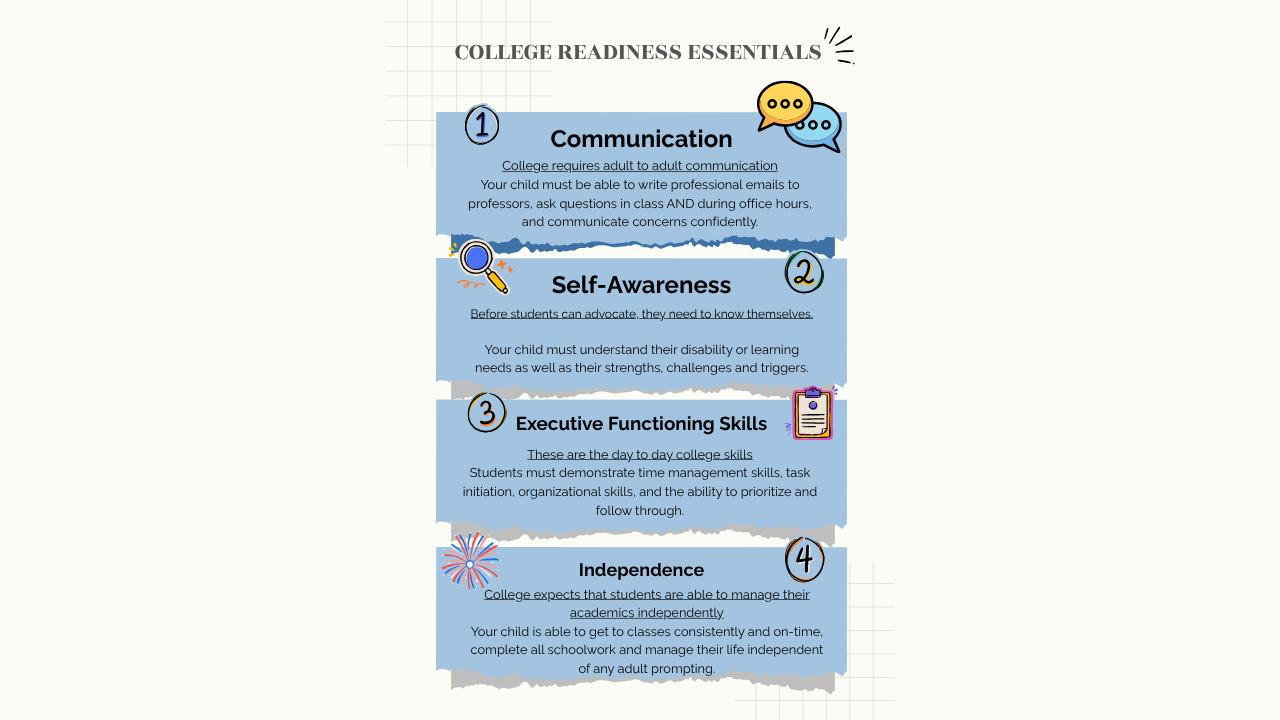
⚠️⚠️⚠️⚠️ But I need you to know this... "high school readiness" doesn't exactly equate to "college readiness". College brings new expectations, less structure and higher demands on time management and follow through.
Take a look at this:
What you can do right now!!
✅ Review their IEP or 504 together or simply talk about how they learn best
My guess is that you may know this document like the back of your hand, but does your child? 🤔
I know this all too well as a special education teacher. Can you believe that it comes as a surprise to some of my students that they may learn differently than other students? In high school, the IEP follows your child. Teachers know it, services are built in, and adults are responsible for making sure supports happen.
In college, that all changes.
Sitting down together to review the IEP helps your child:
-
Understand their disability or learning difference in clear, real-world terms
-
Recognize which supports actually help them learn (and which don’t). This is probably a good time to start thinking about which of these supports likely won't be available in college ( and unfortunately, that will be a majority of them).
-
Build the language they’ll need to self-advocate with professors and disability services
-
Gain confidence instead of fear when supports are no longer handed to them.
For parents, this review is a chance to shift roles. You’re moving from “fixing” to “coaching,” which is exactly what college requires. This is something you will hear a lot from me.
💡When students head to college without understanding their IEP, they often wait too long to ask for help—or don’t ask at all. And that is scary to think about it!
✅ Practice sending short, respectful emails
In high school, students don't have enough opportunities to practice this important skill. Parents step in, teachers check in, and reminders happen automatically. In college, email becomes the primary way students communicate with professors, advisors, and disability services—and the expectation is that students handle this independently.
Practicing now helps students:
-
Learn how to ask questions clearly and respectfully
-
Communicate about absences, extensions, or confusion before problems grow
-
Understand appropriate tone, subject lines, and professional language. You would not believe some of the emails I have received.
(I should probably put some of the highlights together and write a book. 😂)
-
Build confidence reaching out instead of avoiding communication
For many students, especially those with learning differences or anxiety, sending an email can feel overwhelming. Practicing short, structured messages removes that barrier. It teaches them that emailing a professor doesn’t have to be perfect—it just needs to be clear, polite, and timely.
For parents, this is another opportunity to step back while still providing support. Reviewing drafts together or role-playing common scenarios helps your student build a skill they’ll use constantly in college and beyond.
💡Students who are comfortable emailing tend to get help sooner, build stronger relationships with instructors, and avoid small issues turning into major setbacks. This is what we want isn't it?
✅ Encourage use of planners or digital tools
In college, no one checks in to make sure work is written down or deadlines are tracked. Assignments come from multiple places, schedules change, and students are expected to manage everything on their own. That sounds overwhelming even for me!!
Practicing with a planner or digital tool now helps students learn how to keep track of responsibilities in one place.
Using these tools helps students:
-
See deadlines clearly and plan ahead
-
Break large assignments into manageable steps
-
Reduce last-minute stress and missed work
-
Build independence and confidence
The goal isn’t finding the “perfect” system—it’s helping your student practice using a system consistently.
💡When students enter college already comfortable with an organizational tool, they’re better prepared to handle the pace and expectations of college life.
✅Normalize help seeking as a skill, not a weakness
As a college transition coach, I often encourage parents to coach through challenges instead of fixing them—especially in the months leading up to college. ( I told you I talk about this a lot !)
In high school, it’s natural for parents to step in and solve problems quickly. In college, that safety net disappears. Students are expected to handle setbacks, communicate with instructors, and make decisions on their own. When challenges are always fixed for them, they miss the chance to build those skills.
Coaching instead of fixing helps students:
-
Learn how to think through problems and possible solutions
-
Build confidence in handling setbacks independently
-
Practice decision-making and follow-through
-
Develop resilience when things don’t go as planned
Coaching can look like asking guiding questions, brainstorming options together, or role-playing next steps—rather than taking over. This approach allows students to struggle safely while still feeling supported.
💡When students enter college having practiced working through challenges, they’re better prepared to manage academic and personal obstacles on their own.
I hope that having this information about your child and some real concrete examples of how you and your child can continue to prepare for college helps you. I'm happy to continue to help you in any way I can.
🧘🏻♀️Take a deep breath. You and your child are going to be just fine!
Stacey